Ruchama Noorda
EthericLandScrape, 2023
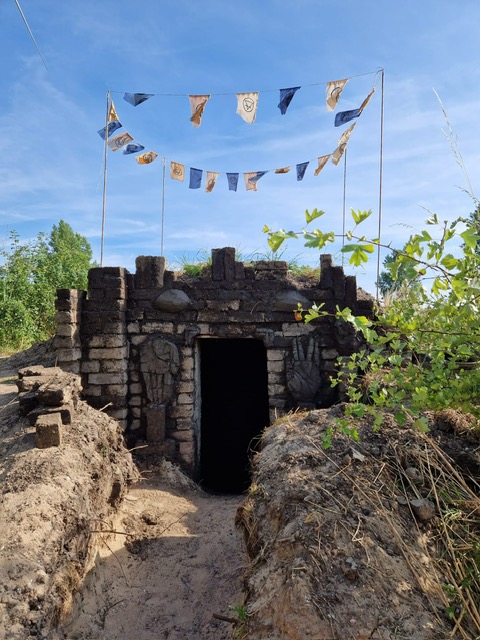
EthericLandScrape is een installatie opgebouwd uit gerecyclede en lokaal gevonden natuurlijke en industriële materialen. De ingang van het bouwwerk is gemaakt uit geperste blokken lokale klei waarop een reliëf is aangebracht. Aan de binnenzijde is met kleurstoffen uit de achterliggende veensloot, klei, kalk en chlorofyl uit brandnetelplanten een muurschildering aangebracht.
De installatie is gebouwd in een uitsparing in het landschap met samengeperste grond. Het is een plek van contemplatie en verbinding met het grotere en natuurlijke geheel: tevens de geest van de plek. Op een locatie aan de rand van Ruigoord, waar de vruchtbare grond van het oude eiland bedekt is met opgespoten zand, graven we door ondergrondse wortelnetwerken – door tijd en bewustzijnslagen – om een tempel te bouwen voor het Symbioceen.
Ruchama Noorda
Ruchama Noorda (1979) is een kunstenaar die gebruikmaakt van diverse media en materialen in performances, beelden en installaties. Noorda omschrijft haar werkmethode als para-conceptueel. Met haar werk onderzoekt zij hedendaagse countercultuur, praktijken en bewegingen. Noorda is afgestudeerd aan de Koninklijke Academie van Beeldende Kunsten in Den Haag (2002) en het Sandberg Instituut in Amsterdam (2004). In 2015 promoveerde zij aan de Universiteit van Leiden met een beeldend onderzoek naar de vroege 20e eeuwse Reformbeweging.
Haar werk is onder andere te zien geweest in O-Town House, Los Angeles (2022), Nest in Den Haag (2021), Garage Rotterdam (2021), Oude Kerk (2015), Mediamatic (2019), Paradiso (2018), Nieuw Dakota (2022), W139 (2013) en de Appel in Amsterdam (2016), Galeria Municipal do Porto in Portugal (2019), Marres in Maastricht (2013), Kunstvereniging Diepenheim (2012), Stedelijk Museum de Lakenhal in Leiden (2007) en Museum Het Domein in Sittard (2003).
EthericLandScrape is an installation constructed from recycled and locally found natural and industrial materials. The entrance to the structure is made of pressed blocks of local clay on which a relief is applied. On the inside, a mural was created using dyes from the bog ditch behind, clay, lime and chlorophyll from nettle plants.
The installation is built in a recess in the landscape with compressed soil. It is a place of contemplation and connection to the larger and natural whole: also the spirit of the place. In a location on the edge of Ruigoord, where the fertile soil of the old island is covered with reclaimed sand, we dig through underground root networks – through time and layers of consciousness – to build a temple to the Symbiocene.
Ruchama Noorda
Ruchama Noorda (1979) is an artist who uses a variety of media and materials in performances, sculptures and installations. Noorda describes her working method as para-conceptual. Her work explores contemporary counterculture, practices and movements. Noorda graduated from the Royal Academy of Art in The Hague (2002) and the Sandberg Institute in Amsterdam (2004). In 2015, she received her doctorate from Leiden University with a visual research project on the early 20th century Reform Movement.
Her work has been shown at O-Town House, Los Angeles (2022), Nest in The Hague (2021), Garage Rotterdam (2021), Oude Kerk (2015), Mediamatic (2019), Paradiso (2018), Nieuw Dakota (2022), among others, W139 (2013) and de Appel in Amsterdam (2016), Galeria Municipal do Porto in Portugal (2019), Marres in Maastricht (2013), Kunstvereniging Diepenheim (2012), Stedelijk Museum de Lakenhal in Leiden (2007) and Museum Het Domein in Sittard (2003).