GROEI – How Forests Think (NL/EN)
Elmo Vermijs
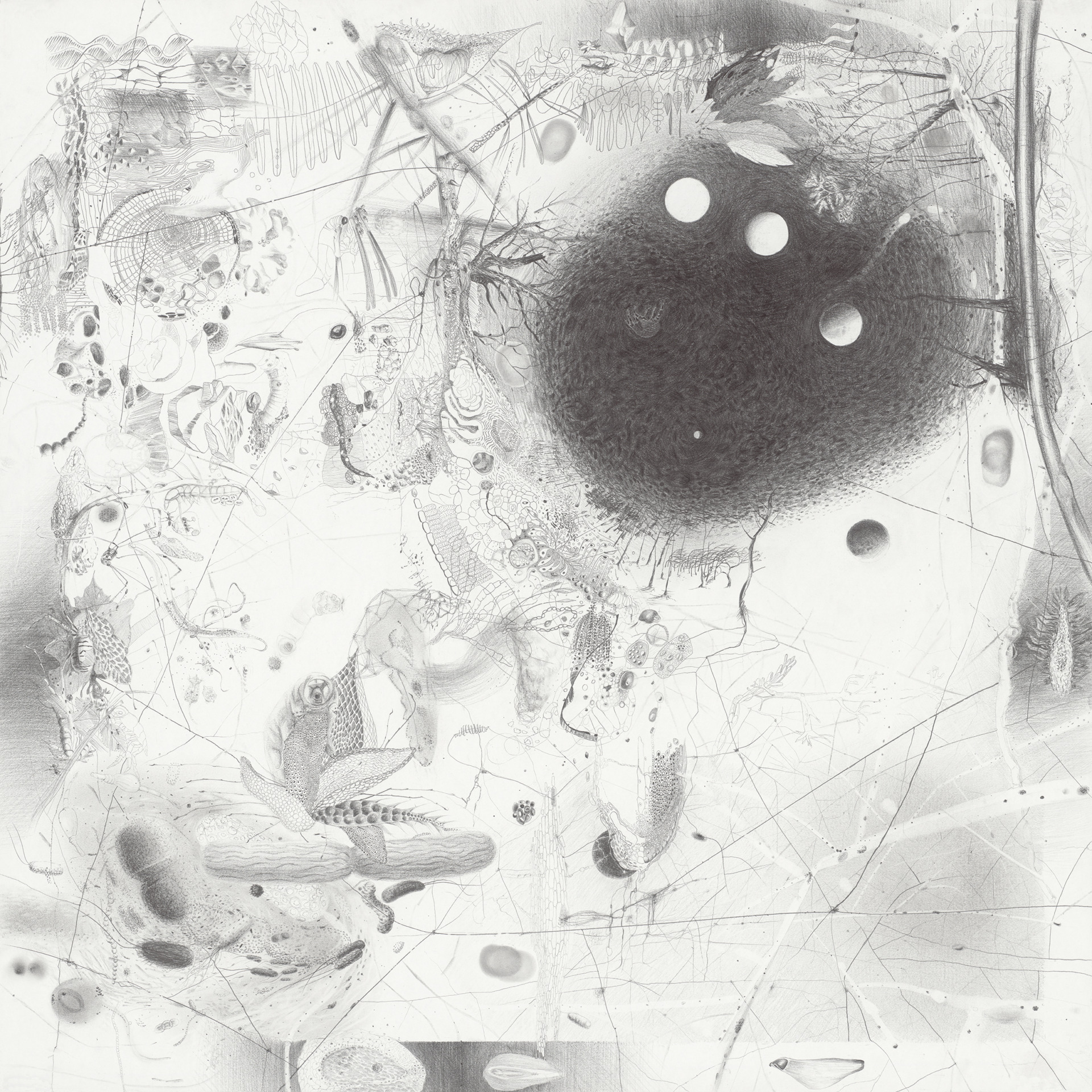
Het organogram GROEI stelt de vraag: wat kunnen we leren van de intelligentie van de bosbodem? Het maakt deel uit van StagingWood, een meerjarig onderzoeksproject van kunstenaar Elmo Vermijs. Samen met wetenschappers, juristen, activisten, bosbeheerders, natuurbeschermers en een lokale houtzagerij onderzoekt hij nieuwe verhoudingen tussen mens en bos. Uitgangspunt zijn de vier stadia van de levenscyclus – ontkiemen, groei, verval en afsterven – die richting geven aan circulaire productieprocessen, installaties, publicaties en publieke programma’s.
GROEI wijkt af van het organogram dat we kennen. Waar traditionele schema’s hiërarchie en overzicht tonen, laat dit handgetekende schema juist een gelaagde en soms onoverzichtelijke structuur zien. Het weerspiegelt de complexiteit van de bosbodem, die miljarden levensvormen en interacties draagt. Dit ondergrondse netwerk fungeert zowel als metafoor als bron van kennis.
Tijdens Oerol op Terschelling werd dit verder onderzocht in de installatie How Forests Think. In een reeks workshops verkenden deelnemers thema’s als toekomstig bosbeheer, het wood-wide web, systeemopstellingen, micro-organismen en het eren van de natuur. De inzichten en gesprekken voedden het organogram, dat door Wouter Engelbart werd getekend.
Zo groeide GROEI uit tot een levend document wat o.a. door Staatsbosbeheer in organisatie en transitievraagstukken werd gebruikt. Het is niet enkel alleen een artistieke weergave van een netwerk, maar ook een uitnodiging tot reflectie en dialoog. Het laat zien hoe kunst, wetenschap en maatschappelijke betrokkenheid samen nieuwe perspectieven kunnen openen op onze relatie met bossen.
GROEI – een organogram
In samenwerking met: Roberto Callisaya, Chihiro Geuzebroek, Remi Hougee, Pieter de Jong, Tanja Dekker, Martine Verweij, Arjan Berkhuyzen.
Getekend door Wouter Engelbart.
Meer informatie: www.stagingwood.org.
Elmo Vermijs onderzoekt de relatie tussen ruimte, (rest)materialen en regeneratieve processen en zoekt naar alternatieve manieren om met actuele uitdagingen om te gaan. Zijn werk verkent de wisselwerking tussen mens en niet-mens, westerse systemen en lokale materialen, steeds bekeken in hun historische, politieke en ecologische context. In nauwe samenwerking met lokale gemeenschappen worden projecten gerealiseerd. Het werk – vaak bestaande uit een installatie en publieksprogramma’s, nodigen bezoekers uit om zelf actief deel te nemen. Door deze interactie wordt het publiek en deelnemers en uitgenodigd diens band met de omgeving te herzien.
The organogram GROWTH poses the question: what can we learn from the intelligence of the forest floor? It is part of StagingWood, a multi-year research project by artist Elmo Vermijs. Together with scientists, legal experts, activists, forest managers, conservationists, and a local sawmill, he explores new relationships between humans and forests. The starting point is the four stages of the life cycle – germination, growth, decay, and death – which guide circular production processes, installations, publications, and public programs.
GROWTH differs from the organograms we are familiar with. Where traditional diagrams suggest hierarchy and clarity, this hand-drawn schema reveals a layered and sometimes confusing structure. It reflects the complexity of the forest floor, which carries billions of life forms and interactions. This underground network serves both as a metaphor and as a source of knowledge.
During Oerol on Terschelling, this was further explored in the installation How Forests Think. In a series of workshops, participants engaged with themes such as future forest management, the wood-wide web, systemic constellations, micro-organisms, and honoring nature. The insights and conversations nourished the organogram, which Wouter Engelbart drew.
Over time, GROWTH evolved into a living document, used, among others, by Staatsbosbeheer in organizational and transition-related questions. It is not merely an artistic representation of a network, but also an invitation to reflection and dialogue. It demonstrates how art, science, and social engagement can come together to open new perspectives on our relationship with forests.
GROWTH – an organogram
In collaboration with: Roberto Callisaya, Chihiro Geuzebroek, Remi Hougee, Pieter de Jong, Tanja Dekker, Martine Verweij, Arjan Berkhuyzen.
Drawn by Wouter Engelbart.
Elmo Vermijs investigates the relationship between space, (residual) materials and regenerative processes and seeks alternative ways of dealing with current challenges. His work explores the interaction between humans and non-humans, Western systems and local materials, always viewed in their historical, political and ecological context. Projects are realised in close collaboration with local communities. The work, often consisting of an installation and public programmes, invites visitors to actively participate. Through this interaction, the public and participants are invited to reconsider their relationship with the environment.