Ruigoord; native vegetation for phyto remediation (NL/EN)
Lennart Lahuis
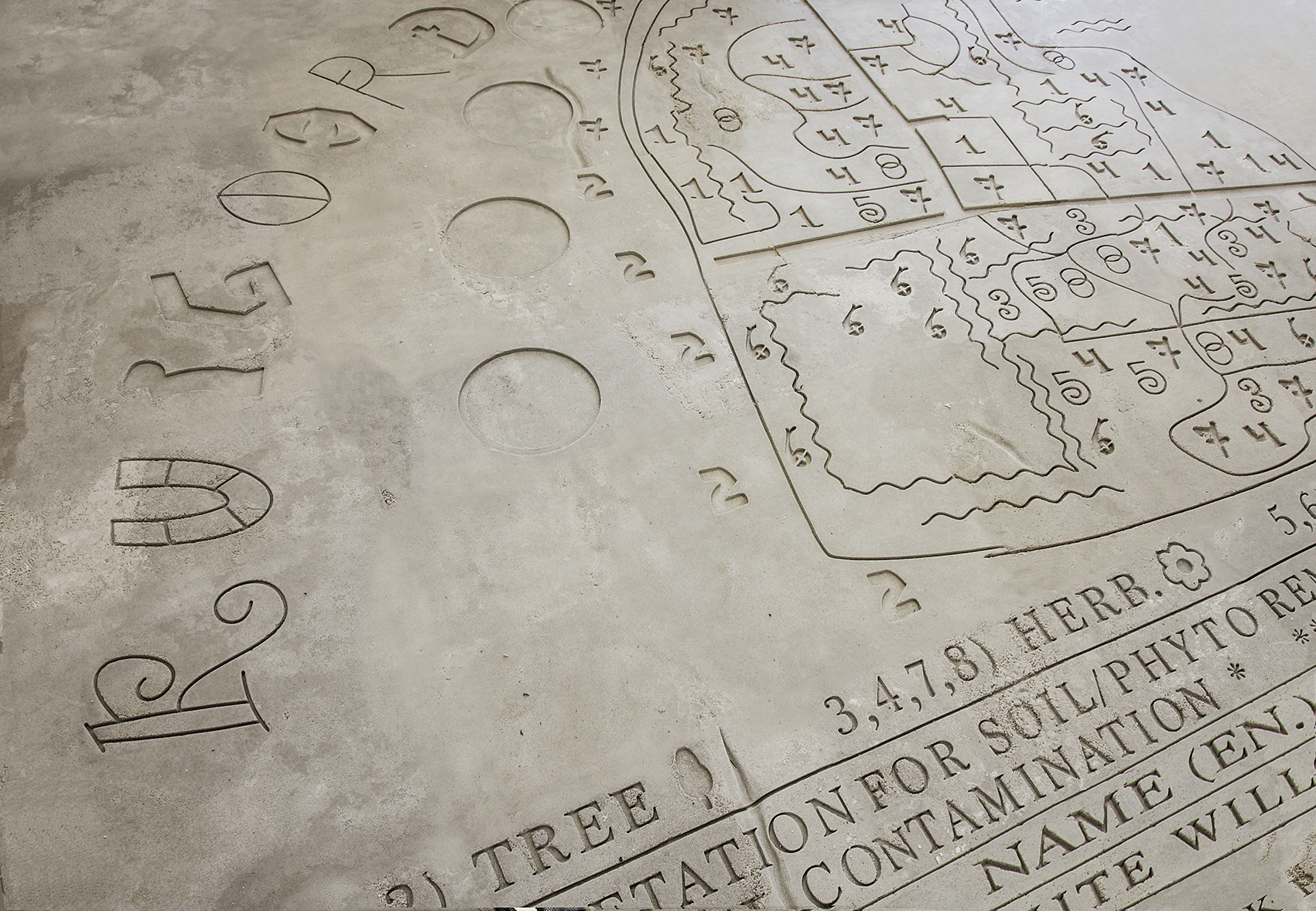
De installatie, Ruigoord; native vegetation for phyto remediation, van beeldend kunstenaar Lennart Lahuis bestaat uit een zandtekening die op magische wijze in de bodem van Ruigoord is aangebracht. Op deze tekening is een kaartje van Ruigoord te zien met een wirwar aan cijfers. Deze cijfers geven de locatie aan van planten en bomen die te vinden zijn in Ruigoord en die in staat zijn bodemvervuiling tegen te gaan door het op natuurlijke wijze af te breken. Onder het kaartje is een tabel te zien die deze planten en bomen beschrijft. De tekening is ondergedompeld in water en is wisselend zichtbaar door de wind op het water en reflecterend zonlicht, het werk is zelden in één blik te overzien.
Deze installatie is het resultaat van een samenwerking met Anke Wijnja van broedplaats de Ceuvel en David Frank van het Ruigoord Archief. Anke Wijnja beheert op de Ceuvel een project rondom fytoremediatie. Fytoremediatie is een techniek en onderzoeksgebied waarbij vegetatie wordt ingezet om verschillende vormen van bodemverontreiniging op natuurlijke wijze tegen te gaan. Lennart Lahuis en Anke Wijnja hebben door deze bril gekeken naar de aanwezige vegetatie op het terrein van Ruigoord. Ruigoord wordt omringd door petrochemische industrie; voor dit kunstwerk hebben Anke en Lennart dan ook specifiek onderzoek gedaan naar aanwezige planten en bomen die petrochemische vervuiling kunnen helpen afbreken.
Informatie en documentatie rondom dit project, dat Ruigoord verkent als een verzamelplaats voor bodem reinigende planten en bomen, zal worden opgenomen in het Ruigoord archief. Daarmee zal deze waardevolle informatie over de vegetatie op dit terrein ook voor de toekomst bewaard blijven en voor anderen beschikbaar worden.
Lennart Lahuis is beeldend kunstenaar. Op poëtische wijze creëert hij situaties waarin de wisselvalligheid van natuurlijke processen en fenomenen samenkomt met de precisie van techniek en wetenschap. De technologische elementen en wetenschappelijke disciplines waarmee hij werkt, worden traditioneel ingezet om kennis te produceren of te bewaren. In zijn werk worden zij echter onderdeel van objecten en installaties waarin vergankelijkheid en entropie centraal staan, en waarin de grenzen van begrijpelijkheid en de materiële voorwaarden voor leesbaarheid worden onderzocht.
The installation, Ruigoord; native vegetation for phytoremediation, by visual artist Lennart Lahuis consists of a sand drawing that has been magically embedded in the soil of Ruigoord. The drawing shows a map of Ruigoord filled with a web of numbers. These numbers indicate the locations of plants and trees found in Ruigoord that are capable of counteracting soil pollution by naturally breaking it down. Below the map, a chart can be seen that describes these plants and trees. The drawing lies submerged under water, appearing and disappearing with the play of wind on the surface and the reflection of sunlight, the work can rarely be taken in at a single glance.
This installation is the result of a collaboration with Anke Wijnja from cultural incubator De Ceuvel and David Frank from the Ruigoord Archive. At De Ceuvel, Anke Wijnja manages a project focused on phytoremediation. Phytoremediation is a technique and field of research in which vegetation is used to counteract various forms of soil contamination. Through this perspective, Lennart Lahuis and Anke Wijnja examined the vegetation present on the grounds of Ruigoord. Surrounded by the petrochemical industry, Ruigoord provided the context in which Anke and Lennart specifically researched plants and trees that are naturally able to break down petrochemical pollution.
Information and documentation relating to this project, which explores Ruigoord as a gathering place for soil-purifying plants and trees, will be included in the Ruigoord Archive. In this way, this valuable knowledge about the site’s vegetation will be preserved for the future and made available to others.
Lennart Lahuis is a visual artist. In a poetic way, he creates situations in which the unpredictability of natural processes and phenomena comes together with the precision of technology and science. The technological elements and scientific disciplines he works with are traditionally used to produce or preserve knowledge. In his work, however, they become part of objects and installations in which transience and entropy are central, and in which the limits of comprehensibility and the material conditions for legibility are explored.